
MODULE 1: Start Here
An overview of the best tool for cognitive awareness
Understanding the Model
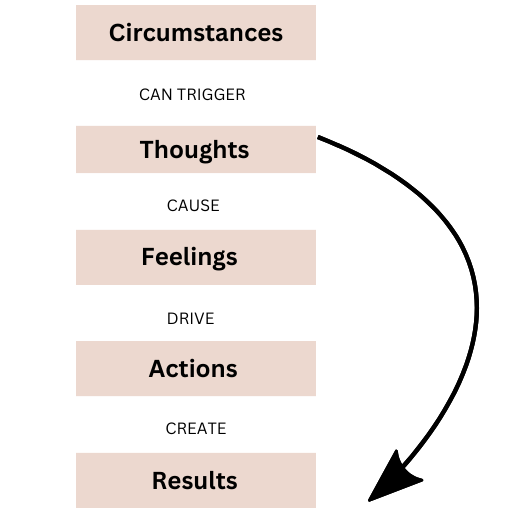
In this program, we will be using a tool to understand the relationship between the circumstances in life, our thoughts, the way we feel, the actions we take, and our results. We will refer to this tool as "The Model", which is an awareness tool. It helps us to understand what we are creating in our life.
The Model was developed by Brooke Castillo and is the foundation of coaching at the Life Coach School. The model shows everything in life fits into one of 5 categories:
Circumstances
Thoughts
Feelings
Actions
Results
To the right is a diagram to help visualize the central idea of the model, which is that our thoughts about our circumstances cause our feelings, which in turn drive our actions, and ultimately lead to our results. Our results typically create evidence for our initial thought which reinforces the cycle.
Circumstances
Circumstances are objective facts. These are things that happen outside of us, such as what other people say and do, the past, the weather, or events going on in the world. Circumstances are things that everyone would agree on and do not include judgements or adjectives.
We often think that circumstances can make us a feel a certain way. For example, receiving positive feedback or having more money in the bank can make us feel good. Or we think that the words that our sister said, or our spouse being late for dinner can make us feel upset, right?
Not so fast. Let’s explore this more deeply.
Thoughts
Thoughts are the meaning our brain gives to circumstances. Our brain's job is to create a story that gives our circumstances meaning. Thoughts are sentences that run through our minds, narrating every moment of our lives.
Sometimes we are aware of our thoughts, but very often we are not. There are many ways to look at a circumstance, and when have an opinion or choose a perspective, we are choosing thoughts. We are creating stories about the facts of our lives. Thoughts are not right or wrong; they just are. Examples of thoughts include “My neighbor is rude”, or “My boss doesn’t appreciate me at work”.
Understanding the difference between a thought and a circumstance is one of the most important pieces of the work we will do together. It is never the circumstance that causes our feelings, but rather, our thoughts that create our feelings.

Feelings
Feelings are emotions or vibrations that we experience in our bodies. They are directly related to the thought we are thinking. Examples of feelings include excitement, sadness, anger, and anxiety. Be careful not to confuse feelings with physical sensations such as hunger or pain, or cold, which are relayed to your brain from afferent neurons.
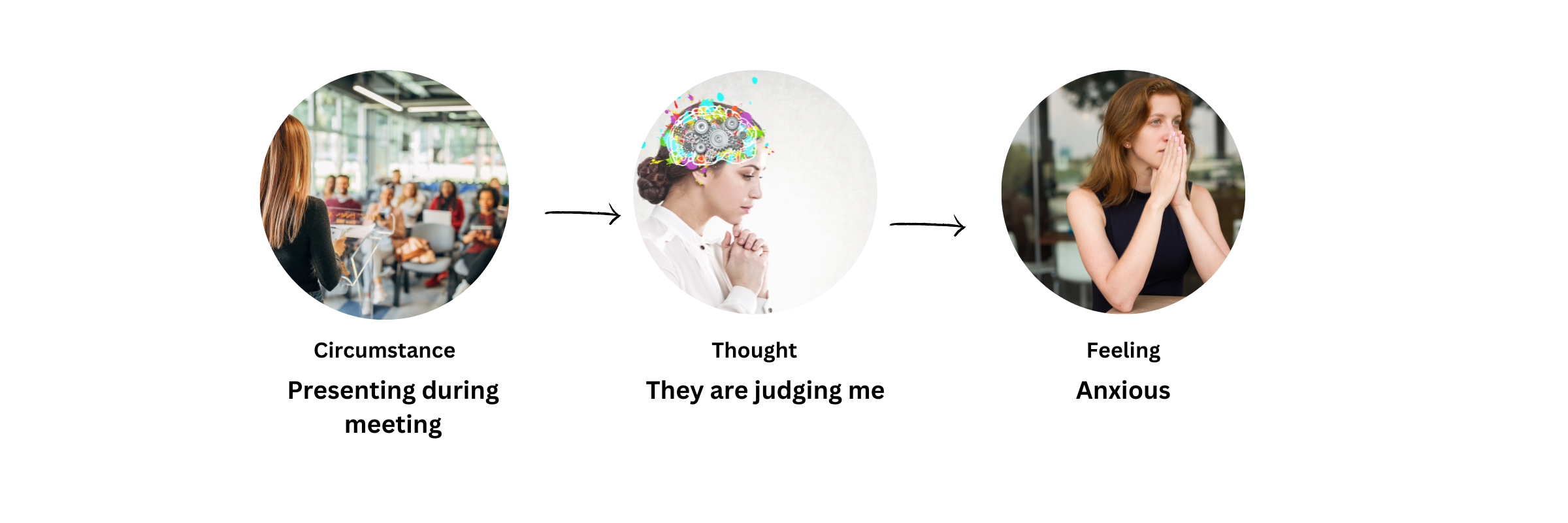
We very often think that our feelings are coming from our circumstances. We think: “I feel stressed because my patient was late and it set me behind". But the truth is, our feelings always come from thoughts. Even though we are not always aware of our thoughts, they are the reason for every single feeling that we have. Our work together will teach you how to separate thoughts from circumstances and facts, and how to pay attention to the emotion that is created.
Actions
Actions are behaviors, reactions, or inactions we take, and are directly related to our feelings. For instance, we may react differently when feeling calm compared to feeling stressed. Consider the example above, and notice how you might be more rushed or dismissive of your patient's concerns, or you might snap at your coworker when they ask for your help.
Your actions will be fueled by the feeling you have, and ultimately, your actions will always create your results. Sometimes actions are subtle, such as pulling away physically from your partner on the couch. Or, it might be inaction, such as avoiding charting or not returning a phone call. While we may try to hide our true feelings, it's often hard to do so without awareness. Positive emotions drive effective actions, and by managing our thoughts and acting from useful and deliberate feelings, we can change our behavior for the long term and experiences big changes and different results.
Results
Results are the effects of the actions we take or don’t take – on us. The results within your control are the ones that impact YOU. Examples include your experience of your job, how you spend your time, whether or not your reach your goals, and how you show up in your relationships.
We often think that results are circumstances that are handed out to us and that they are beyond our control. However, we are entirely responsible for our results because they come from our actions and are a result of our feelings, which comes from the thoughts we choose to think.
Notice that everything you are doing starts with a thought.
Your thought always shows up in your results. Whenever you want to make changes in your life, it is important to start by looking at the thought first. A lot of times we want to make changes at the action level – for example, we want to find a new job, we want to have a difficult conversation with someone, we want to lose weight, or stop drinking. But if you want better and sustainable results, you must do the work at the cognitive level first.
A fascinating thing to notice is that we always prove our original thought true. This is something that you will discover through coaching. What you choose to think is everything.
-
Use the attached worksheet to practice using the model in your own life. Notice how your thoughts create feelings, which ultimately drive actions and lead to results.